Fashion Video Lighting: 5 Setups That Make Clothes Pop
August 4, 2026
Lighting is the single variable that separates a polished fashion video from one that looks amateurish, regardless of how expensive the clothes are or how well the shot is framed. Poor lighting flattens textures, distorts colours, and makes fabric look cheap on screen — the exact opposite of what any fashion brand or creator needs. Whether you are shooting TikTok try-ons, Instagram Reels lookbooks, or product clips for Pinterest, mastering fashion video lighting is non-negotiable. This guide breaks down five proven setups that make clothes pop, explains the logic behind each one, and helps you choose the right approach for your space and budget.
- The right clothing video lighting setup preserves true fabric colour and surface texture, both critical purchase signals for online shoppers.
- Soft, diffused light from a large source is the default best practice for most fashion video scenarios.
- A three-point lighting setup gives you the most control over depth and dimension on any budget.
- Natural window light remains competitive with artificial setups when managed correctly using reflectors and diffusion panels.
- Colour temperature consistency — staying at 5500 K daylight or 3200 K tungsten — prevents mixed-light colour casts that ruin fabric tones.
- AI video tools like Outfit Video can compensate for moderate lighting imperfections, but a strong source always produces a stronger final video.
Why Lighting Determines Fabric Quality on Screen
Cameras do not see the way human eyes do. Where your eye adapts instantly to mixed light sources and reads fabric texture through subtle shadow, a camera sensor compresses that dynamic range into a flat image. Outfit video lighting has to recreate that depth artificially. Three elements define how clothes read on camera: colour accuracy (does the navy read navy, not black?), texture rendering (can you see the weave of a linen blazer?), and specular control (does silk glow beautifully or blow out to a white smear?). Each lighting setup below addresses these three factors differently, and choosing the right one depends on the fabric category and the platform you are publishing to.
It is also worth noting that consistent lighting directly affects post-production time. If you are using an AI video generator to transform outfit photos into short-form clips — as many brands and creators now do — well-lit source images produce significantly cleaner motion and colour output. You can read more about that workflow in What Is an AI Outfit Video Generator?
Setup One: Large Softbox Key Light — The Workhorse
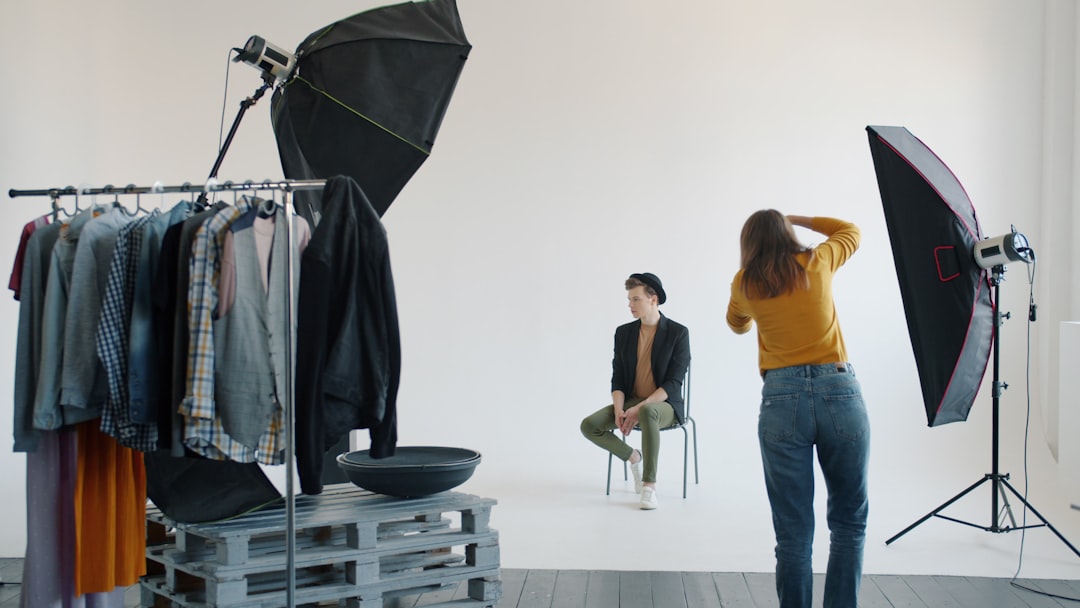
A single large softbox positioned at 45 degrees to the subject, slightly above eye level, is the most reliable all-purpose fashion video lighting arrangement. The large modifier (90 cm or wider) creates soft, wrapping light that reveals fabric texture without harsh shadows. A fill card — a white foam board costs almost nothing — placed on the opposite side bounces enough light back to open up shadows without eliminating depth.
This setup works exceptionally well for:
- Knit and woven fabrics where texture is a selling point
- Full-body outfit videos shot against a clean backdrop
- Consistent batch shooting across a full product catalogue
Keep the softbox close to the subject — within one metre if possible — to maximise the softness of the light. Moving it further away makes it effectively a smaller, harder source.
Setup Two: Three-Point Lighting for Professional Depth
The three-point lighting setup — key light, fill light, and back light — is the television and film industry standard for a reason. It creates controlled separation between the subject and the background, gives the clothing genuine three-dimensional presence, and is highly adaptable to different fabric types by adjusting the ratio between key and fill.
- Key light: Your primary large softbox, positioned at 45 degrees to the subject.
- Fill light: A smaller softbox or reflector on the opposite side at a lower power, typically one to two stops below the key, to reduce shadow density without eliminating it.
- Back light (rim or hair light): A light placed behind and above the subject, aimed at the shoulders or edges of the garment to create a separation highlight that lifts the outfit away from the background.
The back light is particularly effective on dark garments against dark backgrounds, a common styling choice in fashion content. Without it, a black jacket can disappear into a charcoal backdrop entirely.
Setup Three: Window Light with Reflector Panel
Natural light from a large north-facing or east-facing window (in the northern hemisphere) is arguably the most flattering light source available for clothing video lighting — and it costs nothing. The key is control. Direct sunlight creates harsh shadows that are unflattering on fabric. Diffused window light, ideally on an overcast day or with a sheer curtain placed over the window, produces the same quality of light as a professional softbox.
Position your subject within one metre of the window, facing it at a slight angle. Place a white or silver reflector card on the shadow side to bounce light back. This eliminates the need for a fill light in most cases. The limitation is consistency: cloud cover changes throughout the day, and colour temperature shifts from morning to afternoon. If you are batch-shooting content, shoot within the same two-hour window each session to maintain consistency.
Creators building high-volume content — for example, daily outfit Reels or haul videos — often pair this approach with AI video tools to scale output. See how that process works in How Fashion Influencers Use AI to Scale Content.
Setup Four: LED Panel and Ring Light Combination for Small Spaces
Not every brand or creator has space for a full studio rig. For small apartments, compact studios, or shooting on location, a combination of a bi-colour LED panel as the key light and a ring light as a supplementary fill source is highly practical. Bi-colour LED panels allow you to dial in precise colour temperature, which is critical when matching artificial light to ambient room light.
The ring light, when used as a secondary source rather than the primary key, prevents the flat, shadowless look it produces when used alone — a common mistake that makes clothing look two-dimensional. Position the LED panel at 45 degrees as your key, and use the ring light at lower power directly in front of or slightly below the subject to fill without flattening.
This setup is especially relevant for outfit video lighting tips aimed at TikTok and Reels creators working in limited spaces. The total equipment cost for a competent version of this rig is under $200, making it highly accessible for small fashion brands competing against larger players. For more on how small brands are closing that content gap, see How Small Fashion Brands Are Using AI Video to Compete.
Setup Five: High-Key Lighting for Editorial and Lookbook Content
High-key lighting — a setup that minimises shadows and produces a bright, airy, almost shadowless image — is the dominant aesthetic in editorial fashion content, particularly for spring and summer collections. It signals a clean, aspirational brand identity and performs strongly on Pinterest and Instagram, where bright, light-toned images attract more engagement.
To achieve high-key lighting for fashion video:
- Use two large softboxes of equal power placed symmetrically on either side of the subject, angled slightly toward the background to fill the entire frame with light.
- Add a third light or a large white reflector aimed at the background itself to blow it out to pure white or near-white.
- Expose to the bright side: set camera exposure so the brightest fabric tones sit just below overexposure, preserving detail in whites and pastels.
The risk with high-key setups is losing texture on light-coloured fabrics. Control this by keeping at least a small amount of directionality in the key light — do not make it completely flat — so there is still subtle shadow to define weave and structure.
Colour Temperature and Consistency: The Technical Foundation
Every setup above depends on one technical discipline that is often overlooked: colour temperature consistency. Mixed colour temperatures — a daylight window combined with a warm tungsten lamp, for example — produce colour casts that no amount of post-processing can fully correct. Fabric colours shift: a dusty rose reads orange, a cool grey reads green. These shifts destroy buyer trust because the product on screen does not match the product in the customer’s hands.
The standard practice is to commit to one colour temperature per shoot: either 5500 K (daylight) for a clean, neutral look or 3200 K (tungsten/warm) for a golden, editorial warmth. Set your camera’s white balance manually to match, and do not mix sources of different temperatures in the same frame. When using AI video generation tools with your outfit photos, correct white balance in the source image produces significantly better colour fidelity in the final output.
FAQ
What is the best lighting setup for fashion videos on a tight budget?
A large north-facing window combined with a white foam board reflector is the most cost-effective option for fashion video lighting. If natural light is unreliable, a single large softbox (around 90 cm) with a foam board fill card on the opposite side costs under $100 and delivers professional-quality results for most clothing video content.
How do I stop white clothing from overexposing in fashion videos?
Reduce the power of your key light and check your camera’s histogram to ensure the highlights on the garment are not clipping. With a three-point setup, lower the fill light power to introduce more shadow into the fabric and preserve texture. Avoid pointing light sources directly at the white fabric from the front; angling them slightly to the side creates enough shadow to maintain detail.
What colour temperature should I use for clothing video lighting?
5500 K (daylight) is the standard recommendation for most fashion video content because it renders fabric colours most accurately and matches the colour temperature of natural daylight, making mixed-source situations easier to manage. Set your camera’s white balance manually to 5500 K whenever you are shooting under daylight-balanced LED or softbox lights.
Does lighting quality affect AI fashion video output?
Yes, significantly. AI video generators that animate or transform outfit photos into short-form videos rely on clear edge definition, accurate colour, and visible texture in the source image. Well-lit source photos produce cleaner motion paths, more accurate colour rendering in the video output, and fewer artefacts around fabric edges. Investing in correct outfit video lighting before the AI processing stage improves the final video quality measurably.
Is a ring light good for fashion video?
A ring light used as the sole light source produces flat, shadowless light that makes clothing look two-dimensional — not ideal for showcasing fabric texture or garment structure. However, a ring light is useful as a secondary fill or catch-light source in combination with a key light such as a softbox or LED panel. Used correctly as part of a multi-light setup, it contributes without flattening the image.
Ready to turn your outfit photos into scroll-stopping videos? Try Outfit Video free and create your first AI fashion video in minutes.
Ready to turn your outfit photos into scroll-stopping videos? Try Outfit Video free and create your first AI fashion video in minutes.